
Fiberglass tissue tape and tissue-scrim composite XJ2550
A non-woven glass tissue mat at 40 g/m², used as the substrate for joint tape and bitumen roofing. Laminated with scrim it becomes a joint reinforcement tape with tensile strength on one face and full coverage on the other.
XJ2550 is a fiberglass tissue tape: a non-woven glass mat of 40 g/m², supplied 50 mm × 25 m, used mainly as the substrate for waterproof roofing materials and for joint tape. It has high tensile strength, corrosion resistance, dimensional stability, water resistance and high porosity, so it saturates quickly with bitumen or with joint compound. Perforated mat is available for air release, and the same mat can be laminated to scrim to form a tissue-scrim composite that carries tensile load in the grid and continuous coverage in the tissue. The mat is listed as XJ2550 on the tissue data sheet and as XJ5025 in the drywall accessory range.
Also searched as fiberglass tissue tape · fiberglass tape · joint reinforcement tape · tissue scrim composite · glass mat · fiberglass mat
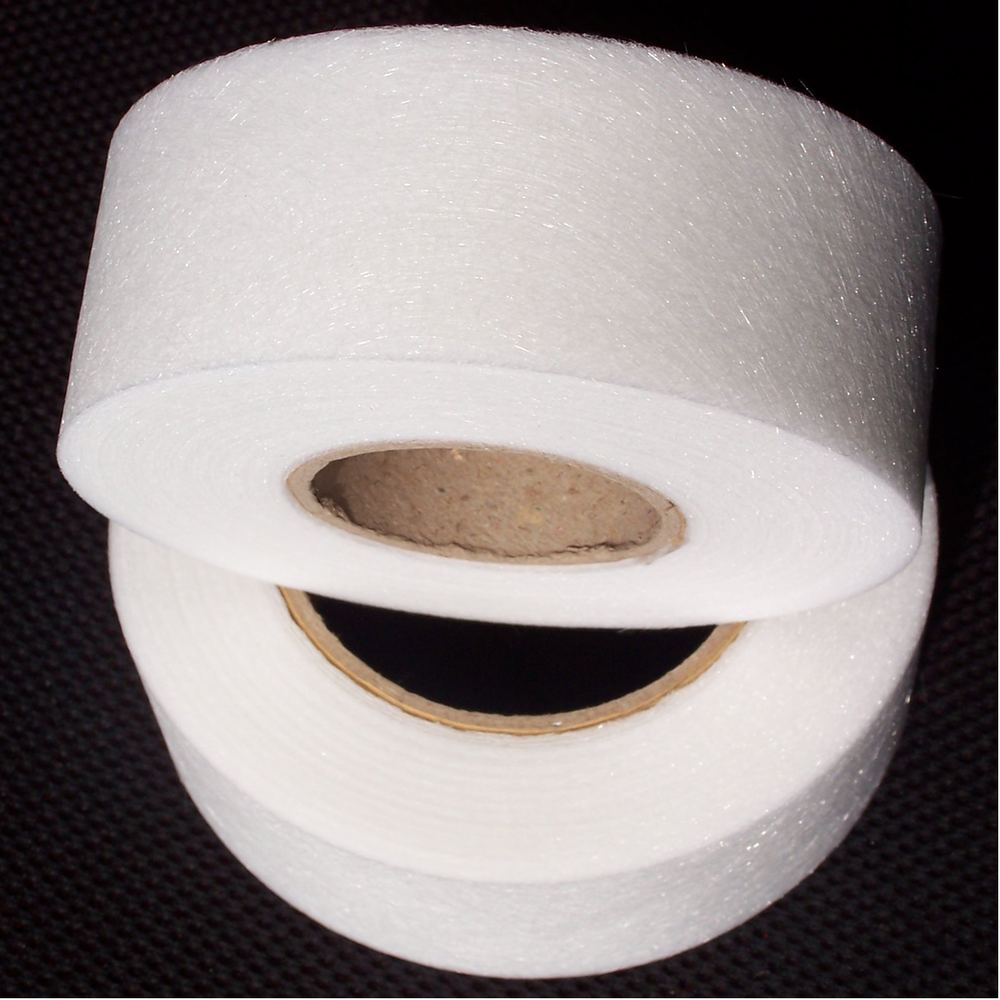
What a tissue mat does that a woven mesh does not
A woven mesh is a grid: strength where the strands are, an opening between them. A tissue mat is a continuous non-woven sheet: less strength, but full coverage, a smooth face and no grid to read through the finish. That is why tissue is the substrate of choice when the material is going to be saturated — bitumen on a roofing membrane, or compound on a joint tape — because there is nowhere for the coating to fall through.
High porosity is the property that makes it work. The mat drinks the bitumen or the compound into its structure rather than sitting on top of it, so the finished sheet is one material rather than a coating on a carrier.
Tissue and scrim together
Tissue and scrim do different jobs, which is why they are often laminated. The tissue gives uniform structure and good coverage — a continuous reinforcement layer, a smooth face, and a proper base for the coating that follows. The scrim gives high tensile strength and dimensional stability: its regular grid becomes a stable reinforcing frame inside the material, which raises tensile performance and cuts dimensional change under load.
Combined, the tissue contributes coverage and uniformity while the scrim contributes tensile reinforcement and stability. For a joint tape that is more than simply stacking two reinforcement layers — it is a structure in which each material does the job it is better at. Basis weight, mat style and composite structure can all be adjusted, so the tape can be matched to the load the joint is expected to carry.
Where it is used
- Substrate for bitumen waterproofing membranes and roofing mat.
- Base sheet for paper-free joint tape and for tissue-scrim joint reinforcement tape.
- Carrier for coatings where a smooth, saturable surface is needed.
- Reinforcement layer in laminates, where the mat improves surface uniformity.
Ordering
Quote by basis weight, width, roll length and whether the mat is plain, perforated or laminated to scrim. The 40 g/m² × 50 mm × 25 m roll is the standard joint-tape format; roofing widths and heavier mats are made to order on the same line.
At a glance
| Model | XJ2550 (tissue data sheet) · XJ5025 (drywall accessory range) |
|---|---|
| Basis weight | 40 g/m² |
| Size | 50 mm × 25 m roll |
| Construction | Non-woven glass tissue; or tissue laminated to scrim |
| Porosity | High — saturates with bitumen, coating or joint compound |
| Properties | High tensile, corrosion resistant, dimensionally stable, water resistant |
| Options | Perforated mat; reinforcement across the full width |
| Use | Substrate for waterproof roofing and joint tape; composite reinforcement |
| Packing | Shrink-wrapped roll, carton; private label |
Specification questions
What is the difference between fiberglass tissue tape and mesh tape?
Mesh tape is a woven grid with open openings and high tensile strength; tissue tape is a non-woven mat with full coverage and high porosity. Mesh is used where movement and strength dominate, tissue where the tape has to saturate and disappear under a coating.
Why laminate tissue to scrim?
Because each material covers the other's weakness. Scrim supplies tensile strength and dimensional stability, tissue supplies continuous coverage and a smooth face, so the composite performs better than either layer alone.
Is perforated mat available?
Yes. The mat can be supplied perforated to let air out during saturation, which matters on bitumen lines and on thick coatings.
Can the weight and width be changed?
Yes. Basis weight, mat style, width and roll length are set per order; the 40 g/m², 50 mm × 25 m roll is simply the standard joint-tape format.
What a quotation needs from you
That is all a quotation needs. We reply within four working hours, China time, with packing, loading plan and lead time — not a price list.
- Manufacturer since 2005
- 36 categories, one container
- Private label or neutral packing
- ISO 9001 & ISO 45001 certified


Enquiry received
We reply within four working hours, China time. For anything urgent, WhatsApp +86 139 6270 9169.
Opens WhatsApp with the message already written.